Table Of Content
- A Short Scale for Measuring Loneliness in Large Surveys
- An Introduction to Research Methods for Undergraduate Health Profession Students
- Basic Description of Multiple-baseline Designs and Threats to Internal Validity
- Early Literature and Development of Methodology of Concurrent Multiple Baseline Designs
- Associated Data
Secondly, researchers can use design techniques that reduce the chance of conflicting updates from different sources. Concurrent validity is similar to predictive validity, as both of these are correlations between a test and relevant criteria. They only differ in the time when these two tests are measured (McIntire & Miller, 2005). For example, researchers have established that the average IQ score of test takers increases by three points every decade. Despite more than a decade of efforts to improve care for patients with acute myocardial infarction (AMI), there remains substantial variation across hospitals in mortality rates for patients with AMI (Krumholz et al. 2009; Popescu et al. 2009).
A Short Scale for Measuring Loneliness in Large Surveys
Recent research has shown that emotional closeness in relationships increases with age. Finally, shifting demographic patterns are changing the contours and context of social relationships (Hughes and Waite forthcoming). Dramatic changes in the family during the past several decades have led to new, more fragmented family structures and increases in the proportion of people living alone. These shifts in the social environment of aging persons will be even more pronounced among future cohorts of elders.
An Introduction to Research Methods for Undergraduate Health Profession Students
An investigation, in Morse and Niehaus’s (2009) view, is focused primarily on either exploration-and-description or on testing-and-prediction. In the first case, the theoretical drive is called “inductive” or “qualitative”; in the second case, it is called “deductive” or “quantitative”. In the case of mixed methods, the component that corresponds to the theoretical drive is referred to as the “core” component (“Kernkomponente”), and the other component is called the “supplemental” component (“ergänzende Komponente”). In Morse’s notation system, the core component is written in capitals and the supplemental component is written in lowercase letters. For example, in a QUAL → quan design, more weight is attached to the data coming from the core qualitative component. Due to the decisive character of the core component, the core component must be able to stand on its own, and should be implemented rigorously.
Basic Description of Multiple-baseline Designs and Threats to Internal Validity
Testing the concurrent validity and reliability of a lipowise digital skinfold caliper to assess muscle mass in healthy ... - ScienceDirect.com
Testing the concurrent validity and reliability of a lipowise digital skinfold caliper to assess muscle mass in healthy ....
Posted: Thu, 22 Jun 2023 13:18:09 GMT [source]
Thus, to demonstrate experimental control, the effects of the independent variable must not generalize; and to detect an extraneous variable through the across-tier comparison, the effects of that extraneous variable must generalize. As Kazdin and Kopel point out, it is clearly possible for treatments to have broad effects on multiple tiers and for extraneous variables to have narrow effects on a specific tier. This is a significant problem for the across-tier comparison because its logic is dependent on these two assumptions. We agree with Greene (2007), who states that the value of the typological approach mainly lies in the different dimensions of mixed methods that result from its classifications. In this article, the primary dimensions include purpose, theoretical drive, timing, point of integration, typological vs. interactive approaches, planned vs. emergent designs, and complexity (also see secondary dimensions in Table 1).
About this article
First the results from the quantitative and qualitative data were integrated using a joint display. The right side provides illustrative qualitative data from the free-text responses on the survey and the mini focus groups. Color matching (see online version) of the box plots and text responses was devised to help the team match visually the quantitative and qualitative responses from the constituent groups. Multiple steps in developing the joint display contributed to an interpretation of the data.
Early Literature and Development of Methodology of Concurrent Multiple Baseline Designs
Including non-concurrent control patients in the analysis of platform trials: is it worth it? - BMC Medical Research ... - BMC Medical Research Methodology
Including non-concurrent control patients in the analysis of platform trials: is it worth it? - BMC Medical Research ....
Posted: Wed, 24 Jun 2020 07:00:00 GMT [source]
Order effects can interfere with the analysis’ ability to correctly estimate the effect of the treatment itself. Multiple baseline designs are the workhorses of single-case design (SCD) research and are the predominant design used in modern applied behavior analytic research (Coon & Rapp, 2018; Cooper et al., 2020). In a review of the SCD literature, Shadish and Sullivan (2011) found multiple baseline designs making up 79% of the SCD literature (54% multiple baseline alone, 25% mixed/combined designs). In addition, multiple baseline designs are increasingly used in literatures that are not explicitly behavior analytic. Smith (2012) found that SCD was reported in 143 different journals that span a variety of fields such as behavior analysis, psychology, education, speech, and pain management; across these fields, multiple baselines account for 69% of SCDs.
As the two data sources provide similar conclusions, the results have greater credibility. Expansion occurs when the findings from the two sources of data diverge and expand insights of the phenomenon of interest by addressing different aspects of a single phenomenon or by describing complementary aspects of a central phenomenon of interest. For example, quantitative data may speak to the strength of associations while qualitative data may speak to the nature of those associations. Discordance occurs if the qualitative and quantitative findings are inconsistent, incongruous, contradict, conflict, or disagree with each other.

What Is Concurrent Validity?
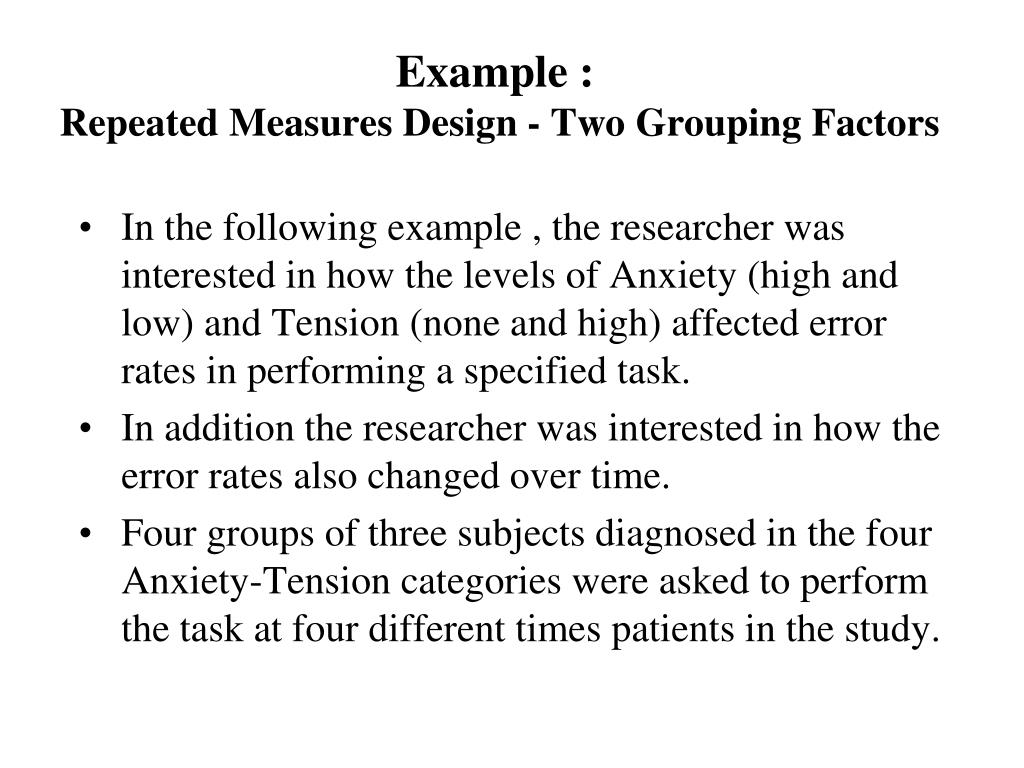
Each study must carefully consider which design meets the specific needs of the study. Studies that use this type of design are as diverse as assessing different advertising campaigns, training programs, and pharmaceuticals. In this design, subjects are randomly assigned to the two groups and you can add additional treatments and a control group as needed. Repeated measures designs don’t fit our impression of a typical experiment in several key ways. When we think of an experiment, we often think of a design that has a clear distinction between the treatment and control groups. When integrating through joint displays, researchers integrate the data by bringing the data together through a visual means to draw out new insights beyond the information gained from the separate quantitative and qualitative results.
In both within- and across-tier comparisons, the dates on which the sessions took place are not relevant to the effects of testing and session experience. Ten sessions of baseline would be expected to have similar effects whether they occur in January or June. Therefore, concurrent and nonconcurrent designs are virtually identical in control for testing and session experience.
The Three-Item Loneliness Scale greatly expands the possibilities for loneliness research in the older population. Loneliness can now easily be measured on large-scale surveys, and the results can be compared with results from studies using the full measure. There are various methods you can use to reduce these problems in repeated measures designs. These methods include randomization, allowing time between treatments, and counterbalancing the order of treatments among others. Finally, it’s always good to remember that an independent groups design is an alternative for avoiding order effects. The purpose of this article is to help researchers to understand how to design a mixed methods research study.
And researchers generally design and implement interventions, select tiers, and employ measures that will likely show consistent treatment effects. Coincidental events might be expected to be more variable in their effect than interventions that are designed to have consistent effects. This assumption was initially identified by Kazdin and Kopel in 1975, but its implications for the rigor of the across-tier comparison have rarely been discussed since that time. These observations lead us to the conclusion that neither of the critical assumptions that coincidental events will (1) contact and (2) have similar impact on all tiers can be assumed to be valid.
Examples could include family events, illness, changed social interactions (e.g., breaking up with a partner), losing or gaining access to a social service program, etc. These coincidental events would contact all tiers of a multiple baseline that include this individual participant, but not tiers that do not involve this participant. In a concurrent multiple baseline that involves a single participant across settings, behaviors, antecedent stimuli etc., this kind of event would be expected to contact all tiers.
The distinguishing feature of a participatory framework is the strong emphasis on using mixed methods data collection through combinations of basic mixed methods designs or even another advanced design, for example, an intervention framework such as an RCT. A similar variation involving an emerging participatory approach that Mertens refers to as transformative specifically focuses on promoting social justice (Mertens 2009, 2012) and has been used with Laotian refugees (Silka 2009). Health services research includes investigation of complex, multilevel processes, and systems that may require both quantitative and qualitative forms of data (Creswell, Fetters, and Ivankova 2004; Curry et al. 2013). Health services researchers use quantitative methodologies to address research questions about causality, generalizability, or magnitude of effects.
In the case of an analytical point of integration, a first analytical stage of a qualitative component is followed by a second analytical stage, in which the topics identified in the first analytical stage are quantitized. The results of the qualitative component ultimately, and before writing down the results of the analytical phase as a whole, become quantitative; qualitizing also is a possible strategy, which would be the converse of this. (c) Illustration – refers to the use of qualitative data to illustrate quantitative findings, often referred to as putting “meat on the bones” of “dry” quantitative findings.
When research questions would benefit from a mixed methods approach, researchers need to make careful choices for integration procedures. Due attention to integration at the design, method, and interpretation and reporting levels can enhance the quality of mixed methods health services research and generate rigorous evidence that matters to patients. Each true mixed methods study has at least one “point of integration” – called the “point of interface” by Morse and Niehaus (2009) and Guest (2013) –, at which the qualitative and quantitative components are brought together. Having one or more points of integration is the distinguishing feature of a design based on multiple components. It is at this point that the components are “mixed”, hence the label “mixed methods designs”. The term “mixing”, however, is misleading, as the components are not simply mixed, but have to be integrated very carefully.
He acknowledged that earlier authors had stated that multiple baselines must be concurrent and he noted that in a nonconcurrent multiple baseline the across-tier comparison could not reveal coincidental events. Hayes argued that “fortunately the logic of the strategy does not really require” (p. 206) an across-tier comparison because the within-tier comparison rules out these threats. Thus, both of the articles introducing nonconcurrent multiple baselines made explicit arguments that replicated within-tier comparisons are sufficient to address the threat of coincidental events. Integration through merging of data occurs when researchers bring the two databases together for analysis and for comparison. Ideally, at the design phase, researchers develop a plan for collecting both forms of data in a way that will be conducive to merging the databases. For example, if quantitative data are collected with an instrument with a series of scales, qualitative data can be collected using parallel or similar questions (Castro et al. 2010).




No comments:
Post a Comment